
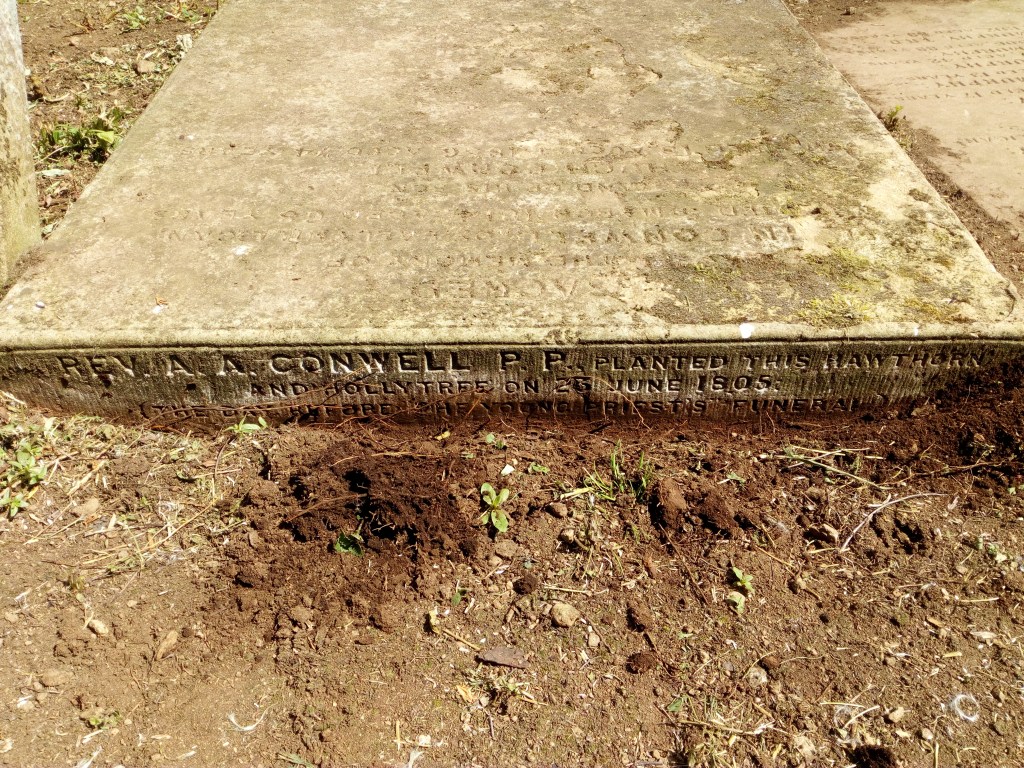
On 22nd July 2023, an article was published by The Belfast Telegraph about Ballyeglish Old Graveyard. It centred upon the finding of a carved inscription on the edge of a grave slab within the Conwell enclosure. The text ran as follows:
Rev A.A. Conwell P.P. planted this hawthorn
and hollytree on 23rd June 1805
(the day before the young priest’s funeral)
The Rev. Arthur Anthony Conwell was 94 years-old in 1805. He had fought at the Battle of Culloden prior to becoming a Franciscan priest. He then remained in the parish of Ardtrea throughout Penal Times and eventually established three churches in the area, two in Ardtrea and one in nearby Newbridge. He was a formidable person.
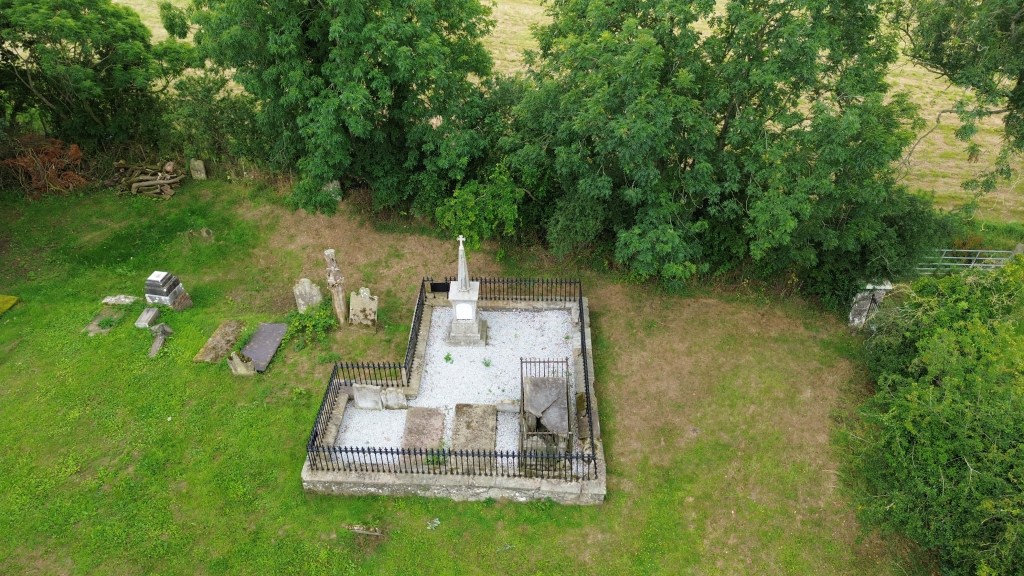
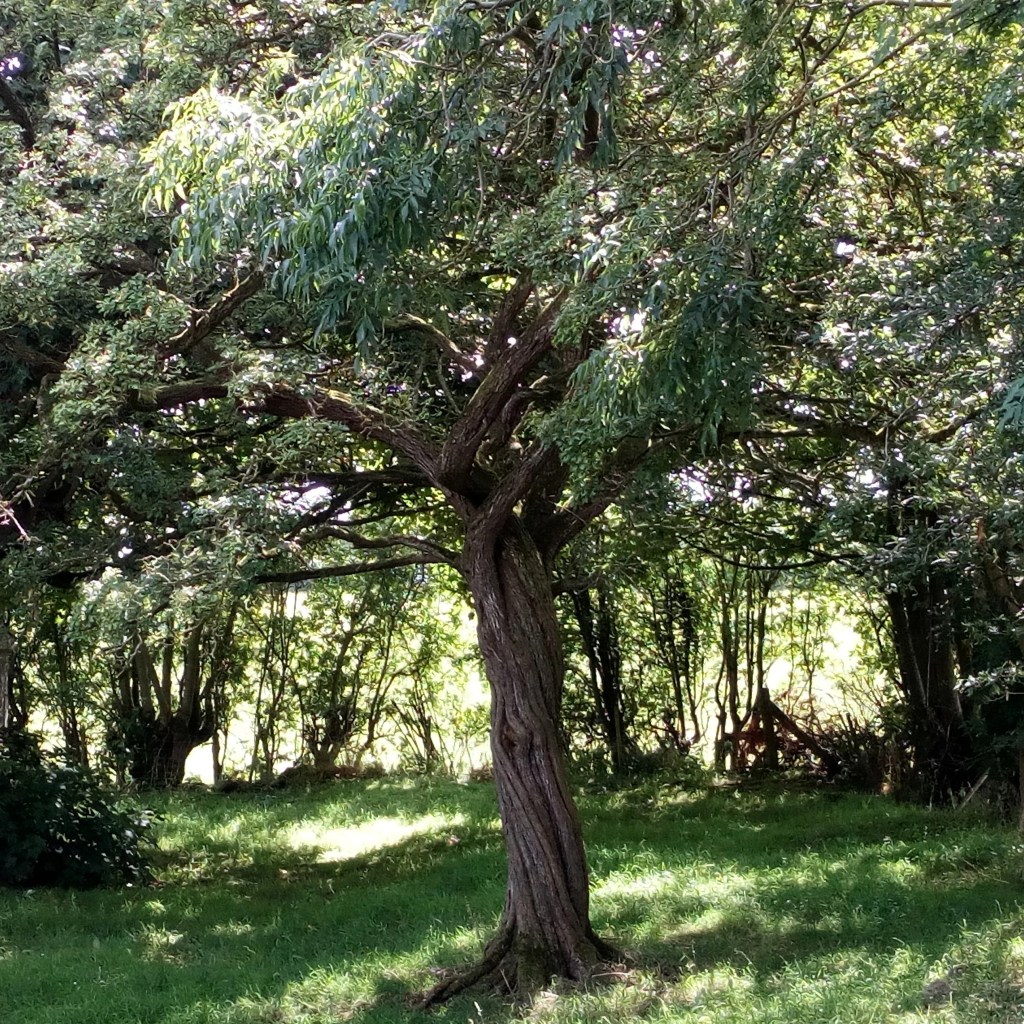
The hawthorn tree he planted (hollytree appears to have been a colloquial affectation) is located close to the elaborate Conwell family burial enclosure. The Ballyeglish Society was always curious as to why a hawthorn was allowed to grow where it did, in the middle of a pathway along one side of the graveyard. The inscription gave us our answer.
The hawthorn tree itself was referred to locally as a Faery Thorn. It was doubly unusual that a tree that has such an association with pagan beliefs should be in such a prominent position within a Christian burial ground.
We might never know exactly why that type of tree was chosen. Perhaps Anthony Conwell had an appreciation for the old stories and the cultural superstitions set out within them. Although clerics tend not to harbour, or at least admit to harbouring, such beliefs, furiously frowned upon as they are by the Church hierarchy, many Irish still have deeply embedded respect for the ways of their ancient ancestors. Those inherent beliefs are not always easy to ignore. Did they seep out in the decision by a very old Catholic priest to plant a tree that he would have known was steeped in paganism?
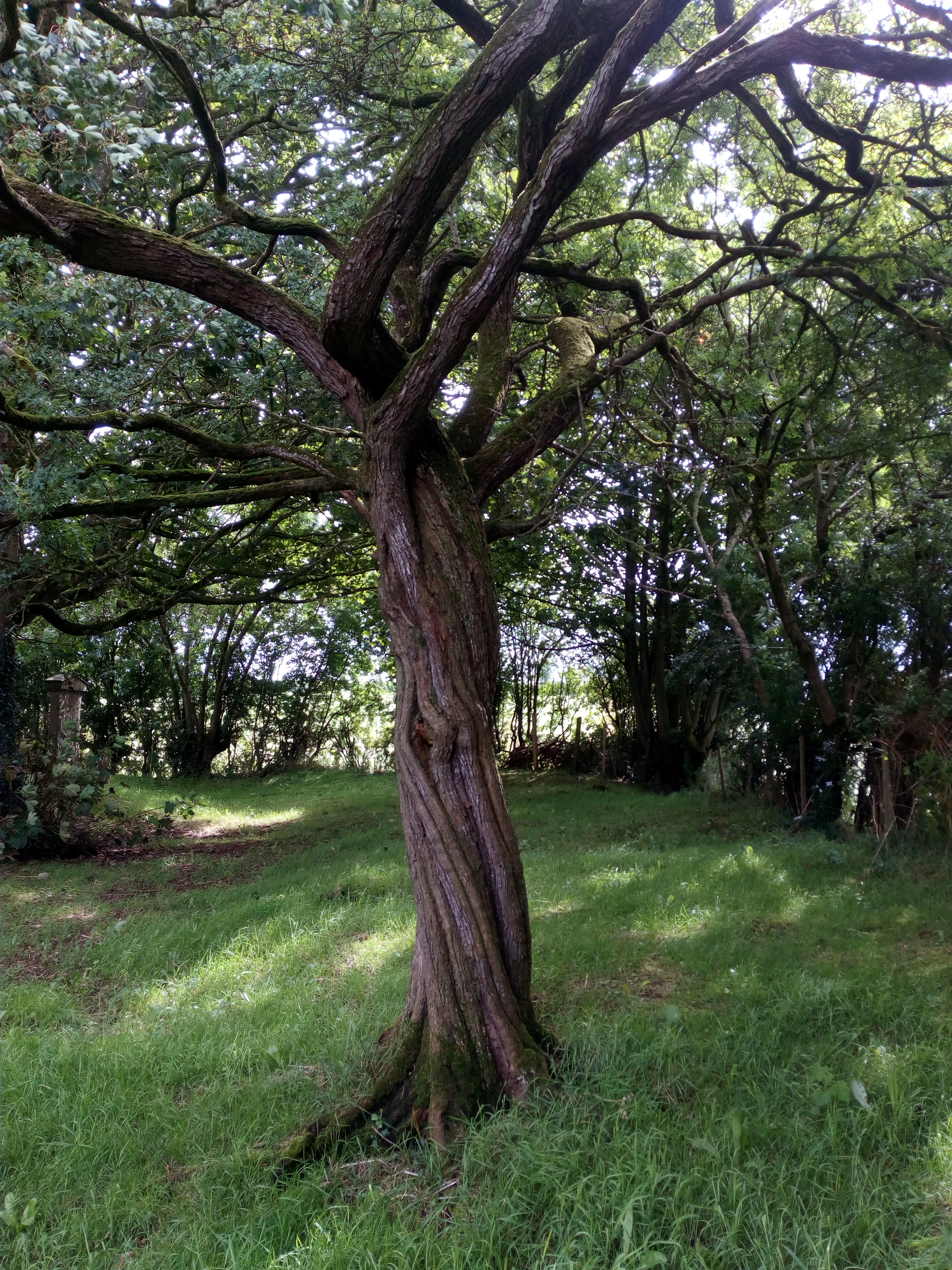
Whatever the reason for his decision, the hawthorn with the beautiful, spiralling trunk still stands today, a majestic artefact. It’s a living link to a storied yet enigmatic cleric, and the multitude of episodes in his life. His tree is unique in Irish history. To place your hand upon that hawthorn is to touch the past; to reach back to The Penal Times, The Battle of Culloden, oppression, conflict and fear. But there was also optimism. Rev. Conwell was a man to whom hope sprang eternal. He steadfastly remained on his path, certain of eventual freedoms, and was rewarded by the relaxation of the Penal Laws after 1768. A new phase of work then began.
Arthur Conwell was born at a time when oppression of denominations other than Anglican was intense. He was not a young man when he took holy orders, being in his late thirties or very early forties. He was P.P. of Ardtrea at age 45, so must have been ordained shortly after Culloden at which time he was 35 years-old. This would suggest that he took a brief break from his clerical preparations to fight in a battle, and records do appear to back this.
It’s curious that someone of that warlike demeanour should decide to become a Franciscan cleric, but that’s what he did. Did some tragedy befall him that influenced his decision to use physical force in 1746, or perhaps drove him into the arms of the church in the first place? Did he struggle through life in attempting to dampen his desire to take up the sword to see justice done, or was the slaughter he witnessed, and the injuries he received at Culloden, sufficient to quell the aggression he carried in younger years? Or was he simply a normal man who is neither wholly one thing nor another, but a twisting dichotomy of conflicting emotion, constantly fighting to go one way but finding that fate has other ideas for him.
We won’t know the full truth about Rev Anthony Conwell. We can only know that he was a man who got things done, even if it meant risking his life. For this we can admire him. He was born in 1711 and died in July 1809. His beloved hawthorn was 4 years-old on the day of his funeral, between 4 and 6 foot tall. We can only hope that the sun shone strong and bright as they buried him within sight of its young foliage, and mysterious meaning.
Here is the link for the full newspaper article, which contains a little more information on this complex character and his hawthorn tree:
Bígí linn

 The Ballyeglish Society
Leave a comment