
A little word now on St Trea who gave her name to the parish in which Ballyeglish Old Graveyard is located. She was born in the 5th Century, during the time of Patrick, patron saint of Ireland. Her father was Cairtheann beg, a great-grandson of Colla Uais who was himself once High King of Ireland (323-326 CE) before being deposed and exiled to Alban (Scotland). Colla Uais later returned to become a king of the new northern kingdom of Airghialla, a territory that he apparently shared with his brother, Colla Da-crioch. Colla Uais took the northern-most portion and his brother the south. Their dual kingdom covered the land from the modern boundaries of Louth, across to eastern Fermanagh, including Monaghan, Armagh and parts of Cavan, up the eastern side of the Sperrin mountains almost to the coast. Part of that ancient territory is still remembered today in the Anglicised name Oriel, which includes parts of Armagh, Monaghan and Louth, greatly diminished from its original stature.
Cairtheann beg eventually gained control of his royal family’s territory from his older brother, Cairtheann Mór (no fan of Patrick), which stretched from modern-day Dungannon all the way up to the Camus, a crossing point on the Lí (Bann), approximately one mile south of modern-day Coleraine.
Relatively little is known about Trea’s life, although more information is available than most are aware of. She was a strong-willed and confident person who had 5 brothers that we know of; Laoghaire, Muireadhaigh, Forgo, Treana and Oilella (gotta love those names). From this group of siblings came 11 saints. It was a sign of how things were then, that clerics and saints tended to come from the aristocracy, the poor being deemed to be of the wrong material for great piety. Oh, the irony. Jesus would be turning in his grave…
The following is taken from the Omnium Sactorum Hiberniae – OSH (even writing that title makes a person feel intelligent):
August 3 is the feast of a female saint, Trea, who has given her name to the district of Ardtrea in County Derry. She is one of those named as having received the veil from the hands of Saint Patrick himself, and in her case, the veil was delivered by an angel. Most of the accounts of Saint Trea which circulate online describe her as an anchoress or recluse, Canon O’Hanlon, however, speculates that she was most likely the head of a religious community. He also mentions that she had a second feast day on July 8:
The account continues:
This pious maiden flourished after the time, when St. Patrick commenced his great mission in the north of Ireland. We have seen already, that a St. Trega or Trea, Virgin, was venerated at Ardtrea, on a different day from the present. A question may arise, as to whether there had been a double festival instituted to honour the same saint. However, on the 8th of July, there is record of a feast for St. Trega, virgin and patroness of Ardtrea Parish, near Lough Neagh. We find, however, that St. Trea inghen Chairthind, or “the daughter of Carthenn,” is recorded in the published Martyrology of Tallagh, at the 3rd of August without stating the locality to which she belonged.
There appears to be no consensus as to why two dates appear for Trea’s feast day. Could she have been so important as to have deserved two, or did the locals fall out as Irish people are wont to do, and a festival schism then ensued? The story in the records mentioned then goes on:
When blessed Patrick had entered the northern parts of the Ulster province, he met with opposition from a dynast in the region of Hy Tuirtre. He had journeyed by Fersait Tuama, until he rested at a very beautiful locality called Finnabhuir. The place formerly called Fersait Tuama, is now known as Toome, near where the River Bann escapes from Lough Neagh and enters Lough Beg, at the division line between the present Counties of Derry and of Antrim. The beautiful district alluded to as Finnabhuir had the wide-spreading Lough Neagh on the east and Slieve Gullin a high ridge of mountain, on the west side. It so happened, that two brothers, one named Carthenn the Elder or “major,” and the other known as Carthenn, the younger or “minor,” had lived in this district. The former a wicked man and addicted to the errors of Paganism had banished his younger brother from that place, in which he exercised complete control. From this district he wished, likewise, that St. Patrick should be ejected. The holy man, like the Apostles, when persecuted in one city left for another, and shaking the dust from of his feet against the tyrannical dynast, predicted that he should fall from power, and serve, with his posterity, under the future rule of the younger Carthenn. He, on the contrary, was virtuous, kindly, and disposed to receive the doctrine of Christ, so that St. Patrick baptized himself, his wife and family. After this time, Carthenn’s wife, Mugania, appears to have given birth to a daughter, destined to a life of grace from St. Patrick’s prophecy regarding her. She was named Trea or Treha at the baptismal font; but, it is not stated, that she had been baptized by St. Patrick.
This information appears to have been drawn from the Vita tripartita Sancti Patricii (Tripartitie Life of St Patrick), the premier source of information for the holy Briton. There are certain questions that have arisen during research by The Ballyeglish Society regarding interpretations taken from that document, but more of that in a future article. In the account from then, Patrick blessed Trea in her mother’s womb and predicted her great future in the faith. The OSH continues:
Through her father, she descended from the race of Colla Uais, monarch of Erinn. From what has been already stated, it should seem, that she was born about the middle of the fifth century. That she grew up in grace and in the practice of all virtues, is generally conceded. She is classed, among the many holy virgins St. Patrick veiled, during the progress of his great missionary career. In accordance with his prediction, when St. Trea began to grow up into girlhood, she felt a strong desire to chose the Son of God for her future spouse. The Apostle had already declared, that she should be a woman of great innocence of life, and that her vesture and dowry should come to her with the veil received at his hands. Therefore, when she sought the illustrious saint for this purpose, and stood before him, an angel was seen descending from Heaven, and placing a veil on her head. It completely covered her eyes. St. Patrick then attempted to lift it, so that she might the better see, but the holy virgin exclaimed, “O pious father, why cannot the veil remain as it has been placed, in its right position?” Wherefore, the holy man replied, “It can very properly thus remain, and its mode of being worn shall be pleasing to your spouse.” As if the cenobite’s veil were glued to the noble lady’s face, the writer of the Tripartite Life and Jocelyn remark most poetically and approvingly, that it covered her dovelike eyes and her soft cheeks, through the whole remaining term of her life. Thus were her eyes and ears remarkably guarded, lest, through such entrances, any dangerous occasion of sin might bring death to ber immortal soul.
See what we mean about her being strong-willed and confident? Trea had her own ideas about things, it seems. With dovelike eyes and her soft cheeks the account might have been describing a chipmunk, or a movie star. Who knows. Trea apparently kept her features hidden for the rest of her life which was a practical measure well ahead of its time, and useful if the feet of local men had a certain aroma. Think Vicks Vaporub on the veil. The above is an interesting reference to her life and not every saint, female or otherwise, was afforded the same. it should be noted that the term cenobites is more readily known these days by fans of the Hellraiser movie franchise, as it is the collective term for the demons who regularly appear, terrors such as Pinhead, Butterball and Torturer. These evil freaks are members of a masochistic religious community known as The Order of the Gash, a perverse cult dedicated to pain (kinda like flagellation in extremis). The original term, cenobite, refers to a member of a monastic community, so is used to describe Trea (oh, the things you learn at The Ballyeglish Society). The OSH bio concludes:
We have no further account of the place where she dwelt in the religious state; but, it is most likely within her ancestral territory, and on the height, which now takes its name from her. This Ardtrea was situated near Lough Neagh and Lough Beg. …In what particular condition St. Trea lived here has not been specified; but, it is probable enough, she was head of a religious community. Nor does the date of her departure from life appear in our annals. In the Martyrology of Donegal, at this same day, we find her name entered as Trea, Virgin, daughter to Cairthenn, of Ard Trea. Whether the 3rd of August, or the 8th of July, be the commemoration for her death, has not been recorded.
It’s unfortunate that the death of a saint of noble lineage is not recorded in either the Annals of Ulster nor those of The Four Masters. Brigid of Faughart/Kildare, Brónach of Caisleán Ruairí and Blinné (Moninna) of Killeavy are all afforded that measure. Perhaps there was too much other serious stuff going on at the time of Trea’s death, and her passing fell between the cracks of what passed for journalism at that time, or perhaps the chronicler was holding a grudge regarding Trea’s family history. The latter is not unknown in Irish historical accounts. The mystery surrounding the date of her death may also explain the two dates for her feast day.
Ard Trea means the Height of Trea. We don’t know what height Trea was, but if she was anything like other women from the loughshore area then her size didn’t matter, she would still have been formidable and a dab hand with both rolling pin and wooden spoon. Ardtrea Church, between Drummullan and Stewartstown, is built upon an obvious ard, a natural feature in that landscape. It is close to Lough Neagh but not Lough Beg, so we can see how historical accounts are not always entirely accurate. Strangely, the Anglican church there today is named not for St. Trea but for St Andrew, a sign of how sometimes churches were rededicated. There are many extremely old graves to be found there. No one appears to know who resides within them. There can also be seen the remains of a previous ancient building. Further research is needed to fill out that story.
The original parish of Ardtrea, often written as Artrea, extended north to modern day Newbridge. This was before the county system was created by the newly present colonial administration in mid-Ulster after the fall of Gaelic Ireland circa 1607. It was eventually reduced in size in both Catholic and later Anglican parishes.
Today, the Catholic parish of Ardtrea encompasses the villages of The Loup and Moneymore, omitting entirely the original location for Trea’s first religious site. The Anglican parish encompasses both Ardtrea and Desertcreat, the latter being another early Christian site.
We know so little about Trea’s life and no archaeology has been undertaken to discover more. As stated above, she is reputed to have a feast day on 3rd August, but may also have one on 18th July under the name St Trega. It’s probably best to celebrate both, and both are likely to have decent weather, unlike either Patrick‘s or Bríghid’s special days.
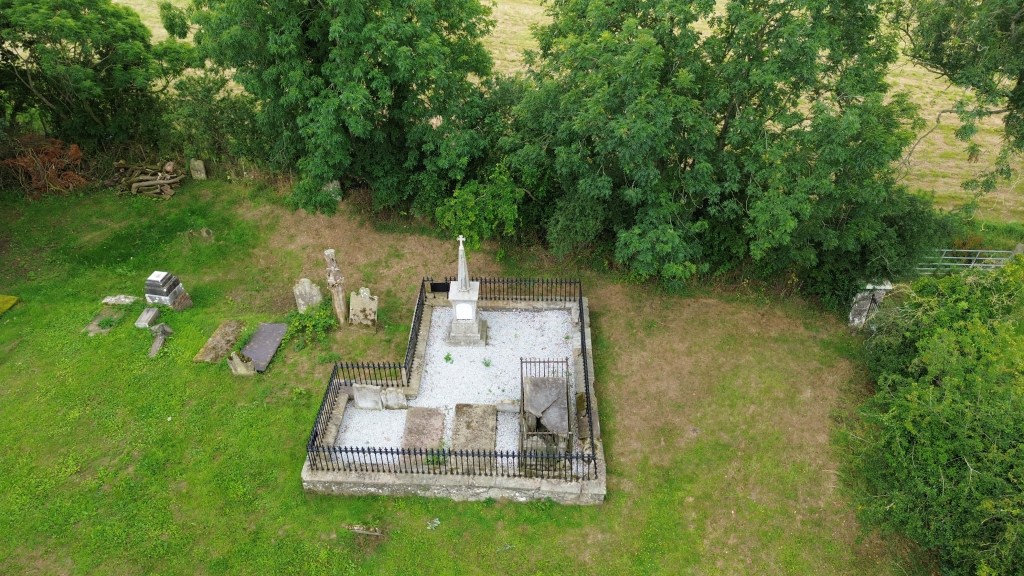
Given the great antiquity of Ballyeglish Old Graveyard, and its previous place within the very old parish of Ardtrea, we can only presume that Trea oft visited the site in bygone days, perchance to reprimand local men for breaking wind and scratching where they shouldn’t when in polite company. The holy well would certainly have been a sacred site at that time, so we can only guess at how many times Trea knelt by that holy font to touch its waters. If only we had photos…
(note: the article image we used is of a stained-glass church window showing a depiction of St Trea. Her face is uncovered…)

 The Ballyeglish Society
Leave a comment