
Ballyeglish Old Graveyard is not just a pretty face. It also provides us with a selection of mushrooms to pique our curiosity. Although many mushrooms found growing wild in Ireland are edible, many are not and can kill if ingested. Sorry to scare, but it’s true. Picking wild mushrooms is not for everyone and here, at The Ballyeglish Society, we practice the approach of if in doubt, leave them out – best to consult an expert before eating.
In this article, we take a brief look at some of the mushrooms we have seen in this ancient burial place, and a glimpse at two others that we haven’t yet observed, but which we believe might be of interest to viewers of this site. The information given is not complete or conclusive, but will hopefully serve to whet your appetites for these wonders of nature.
First up, we have the Shaggy Scalycap, which would be a good name for an Irish hip hop band. It can be seen growing close to the holy well, at the base of the old ash, in Old Eglish. For nerds, the scientific name for this specimen is Pholiota squarossa. It’s also known as the Shaggy Pholiota, which might be a good name for an Italian hip hop band. By the way, the scientific name for ash is Fraxinus excelsior, which is a good name for a posh hip hop band made up of altar boys (or would that be alter boys if they have transitioned…?).
In the photo below, we can see a before and after for this particular mushroom. It’s incredible how they can completely transform, or is that transition, from one shape to another, appearing as two entirely different organisms. It’s much like caterpillar to butterfly. The bottom image also shows the location of some of the scalycaps at Bríghid’s Well.
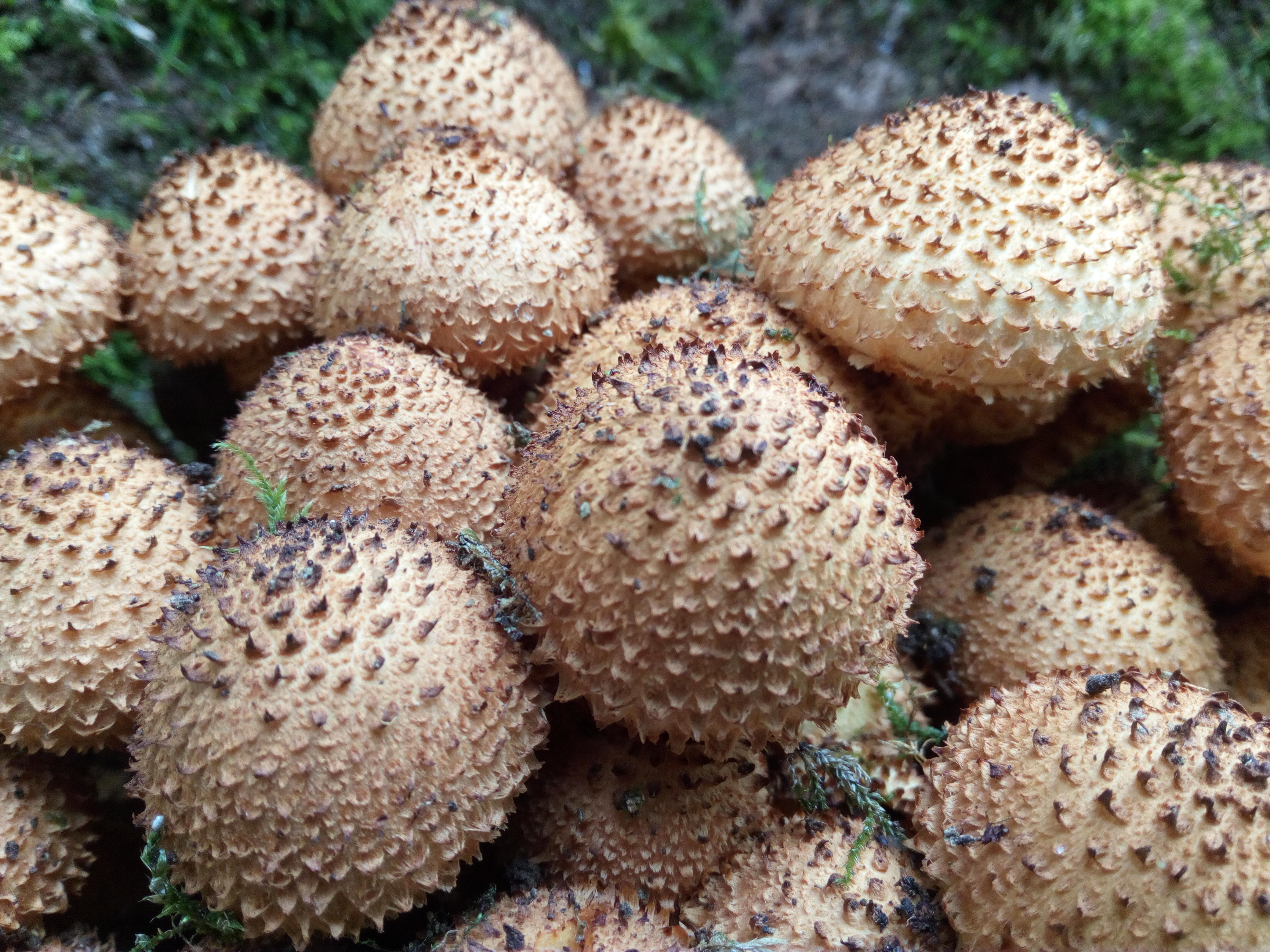
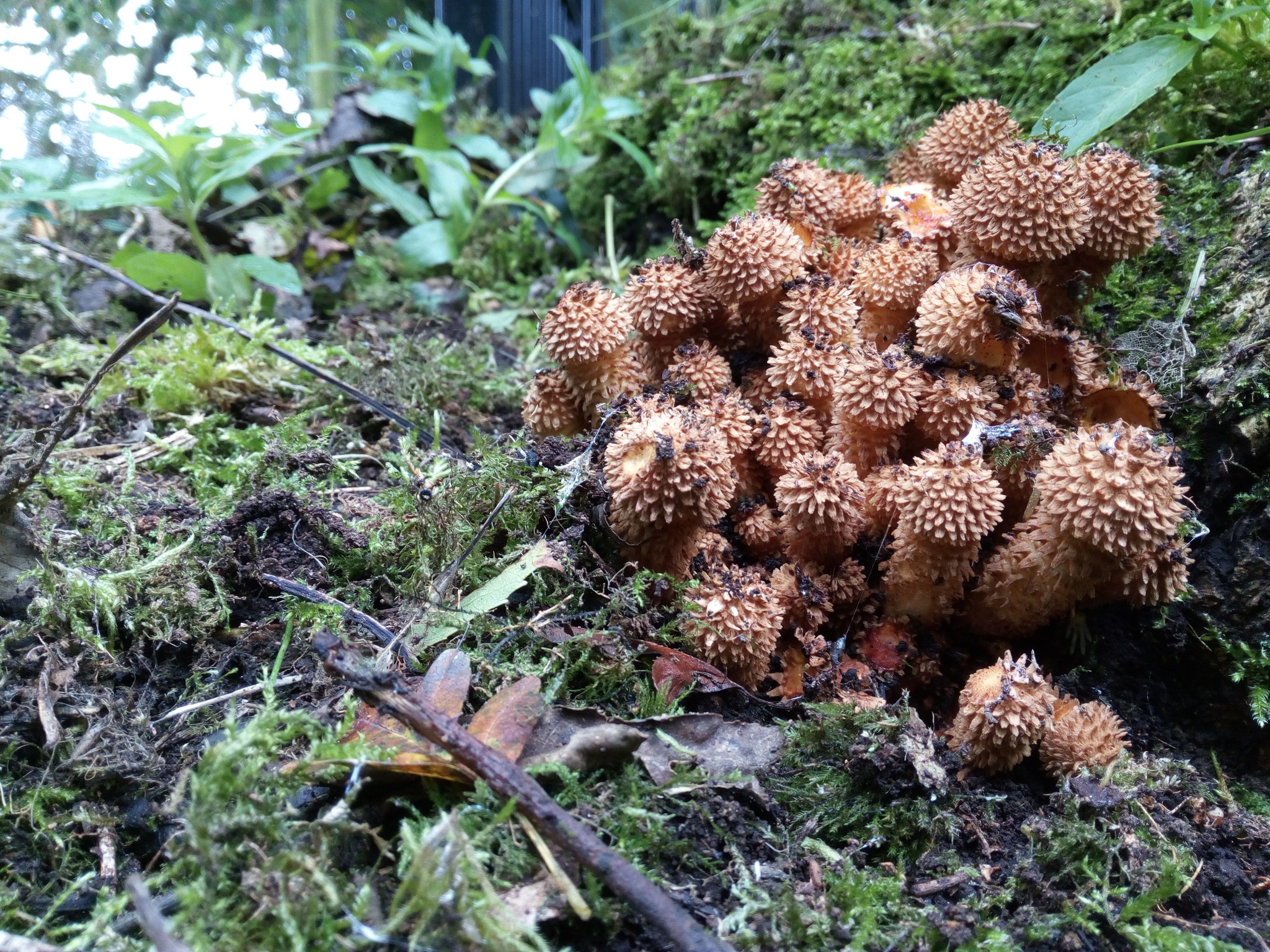
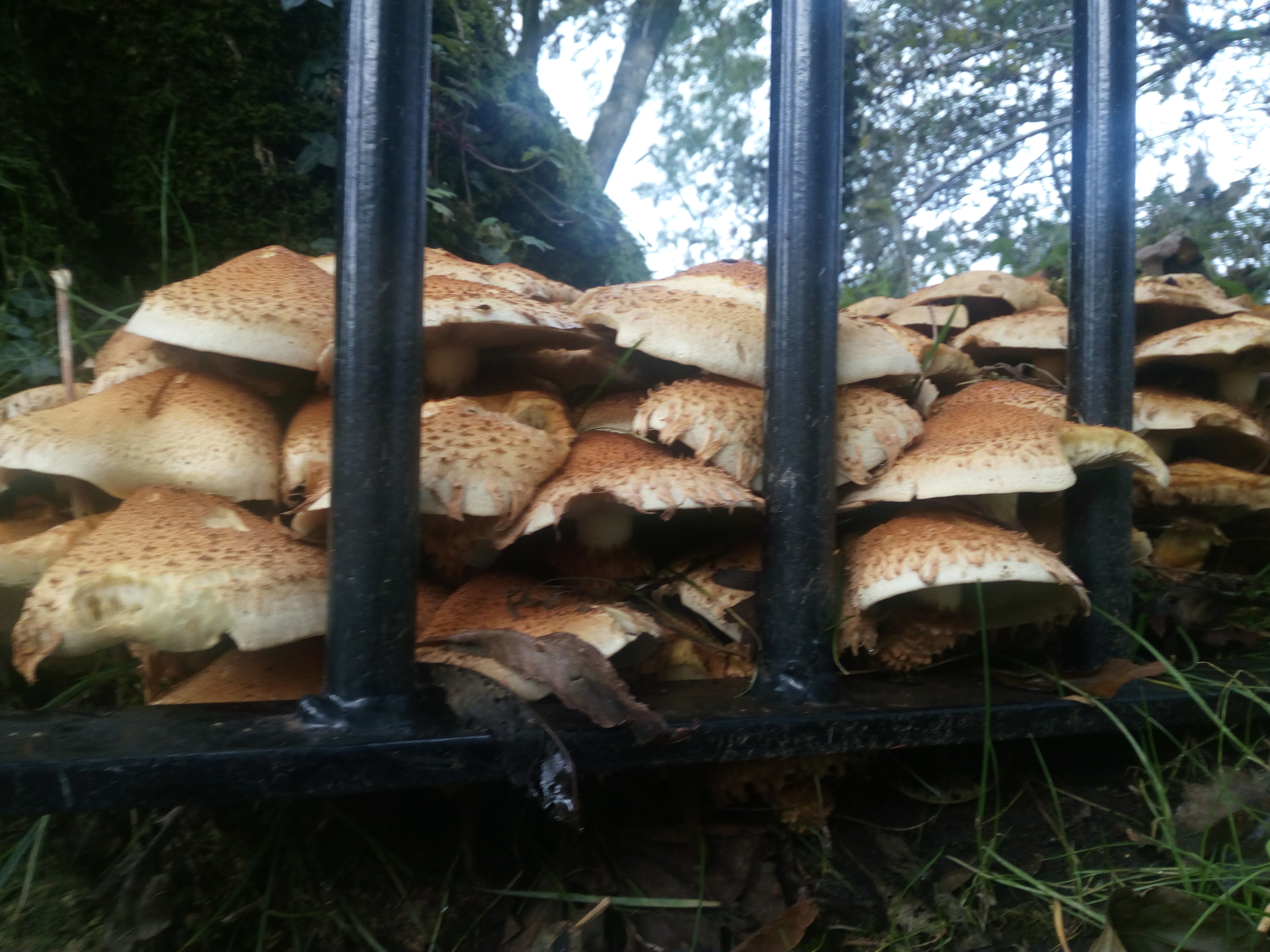
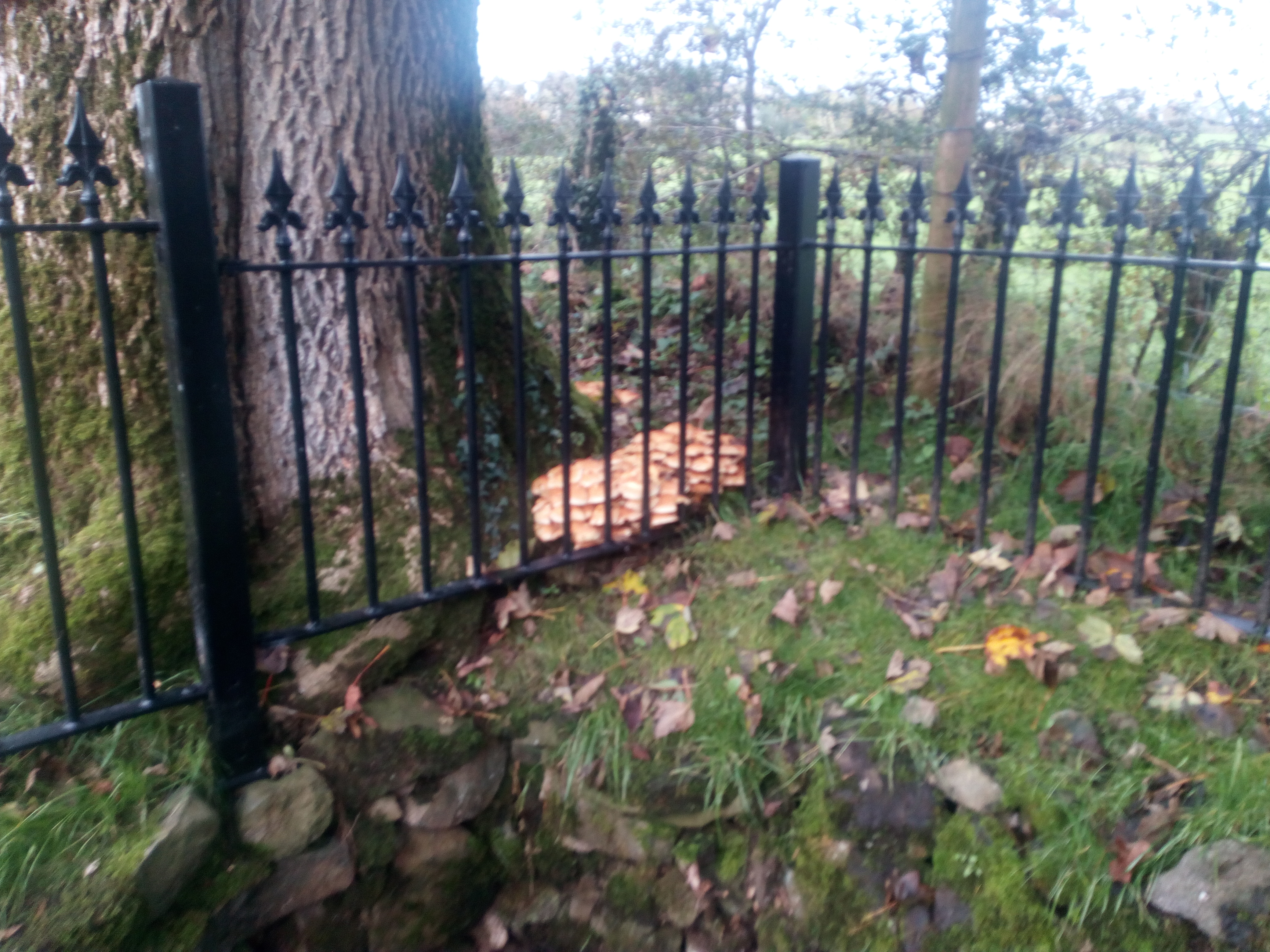
Although some claim that the Shaggy scalycap is edible, there have been reported cases of poisoning. Interested parties argue that drinking alcohol when eating the scalycap creates a toxic combination which causes the fairly serious problems. The Ballyeglish Society has an aforementioned cautious approach to all wild mushrooms. We will repeat, If in doubt, leave them out. Might be best to avoid this particular fungus if feeling peckish. Try some muesli instead.
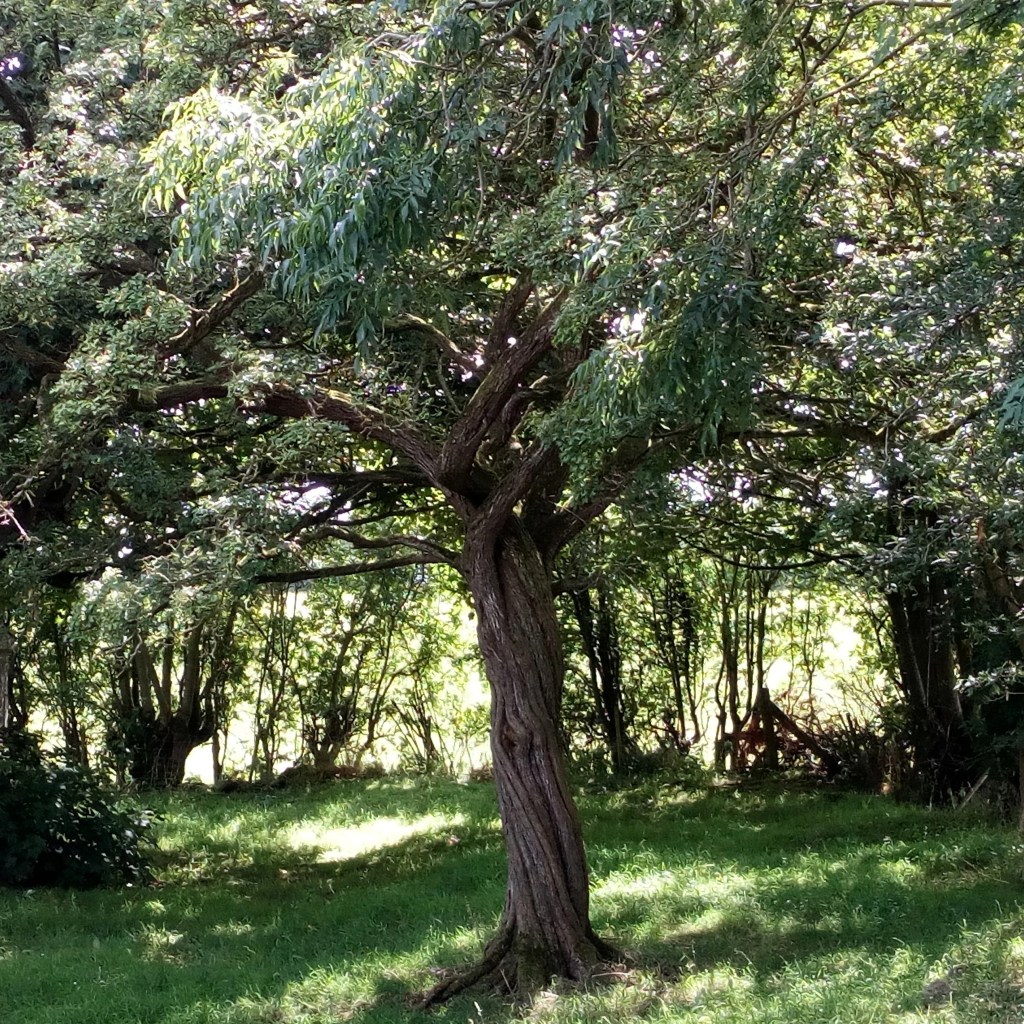
The shaggy scalycap is considered a secondary parasitic organism, that attacks trees such as ash, that have already been weakened by some other means. The ash at the holy well of Eglish is very old, approximately 200 years by our estimations, so its advanced age would have left it susceptible to scalycap intrusion. However, that does not mean that the tree is in imminent danger of collapse, only that the mushrooms are symptoms of other ailments. The ash tree at the Bríghid’s Well will be there for many years to come as no doubt will the companion mushrooms.
There is no suggestion that the scalycap is hallucinatory if accidentally ingested. We do wonder, though, if “magic” mushrooms of any stripe were to fall into a holy well in sufficient quantities, and the infused water then drank, would we see locals having visions, and meetings with their spirit guides as per shamanic tradition? Would they have a dream of Henry Joy McCracken GAC winning back-to-back All-Ireland senior football titles? Now, that would be a strong hallucinatory effect (wink wink, Moneymore).
Next up we have the Honey Fungus, scientific name – Armillaria mellea. This is an interesting one, and we include it as its sometimes mistaken for the Shaggy scalycap.
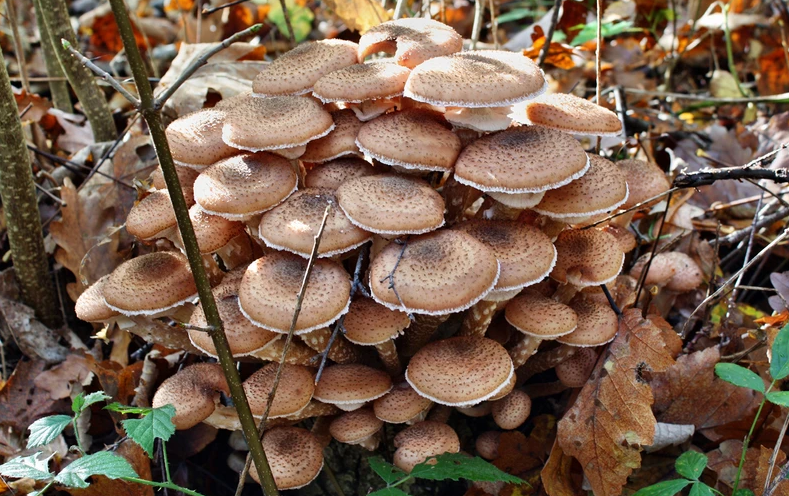
The Honey fungus lives on both alive and dead trees and woody shrubs. The genus Armillaria has a number of variants, but is regarded as the largest living organism on our planet. One specimen of the ostoyae variety lives in the Malheur National Park in Oregon in the USA. It’s known locally as The Humongous Fungus and the name is well-earned. It is said to cover an area of 3.7 sq. miles of 2400 acres. That’s almost eight and a half times the area of the townland of Moneymore. It is estimated to weigh 31,500 tonnes making it the largest living organism in the world, and is reckoned to be about 2,500 years-old. Ain’t that mad! If only it could talk.
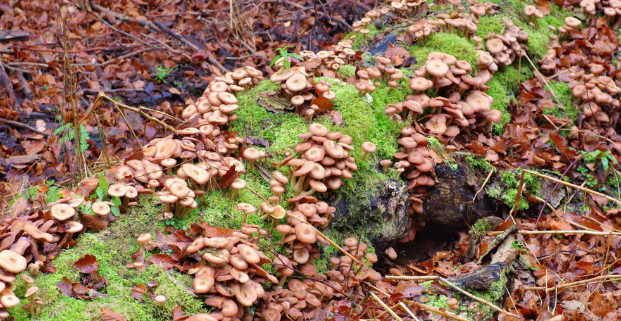
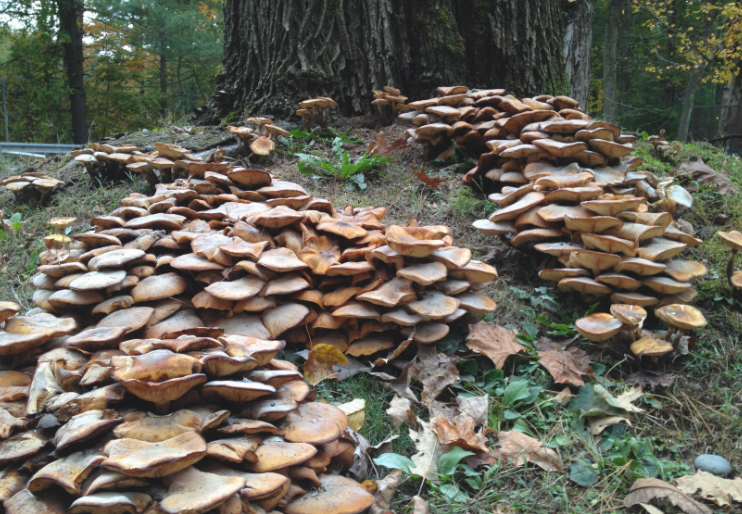
Trivia time – The X-Files had an episode which featured a fanciful version of this huge organism. Titled Field Trip, it was Season 6, Episode 21. The huge fungus almost consumed both Mulder and Scully, but thankfully both avoided becoming risotto, and survived to continue chasing those pesky aliens.
Some types of Armillaria display bioluminescence resulting in the phenomenon of Foxfire, an eerie glow that occurs wherever such fungus grow. How many ghost stories and fairly tales emerged because of Foxfire?
It is also a very destructive forest pathogen, as Mulder and Scully can both attest to. Phew, they came so close… The fungus causes white rot root disease, and can completely kill selected plant-life as it also lives on the dead material, so has no need to moderate its parasitic behaviour on the living hosts. Once the ground is infected with Honey fungus, it is very difficult to eradicate, requiring brutal digging. On the bright side, it is ranked highly by some in term of its taste. Honey Fungus must be thoroughly cooked before eating, however, as they are mildly poisonous if consumed raw. Like Scalycaps, it is considered a dangerous food if eaten with alcohol, as toxins are formed. It’s recommended to avoid alcohol at least 12 hours before, and 24 hours, after eating this particular mushroom. Remember, If in doubt, leave them out.
The Parasol mushrooms are back at Ballyeglish. The photos show one before and many after, as the fungus opens out. These are edible but please do not take our word for it. Again we advise that it’s always advisable to check with an expert before eating wild mushrooms (just in case). In any event, we think they’re very beautiful. Nature’s delights.
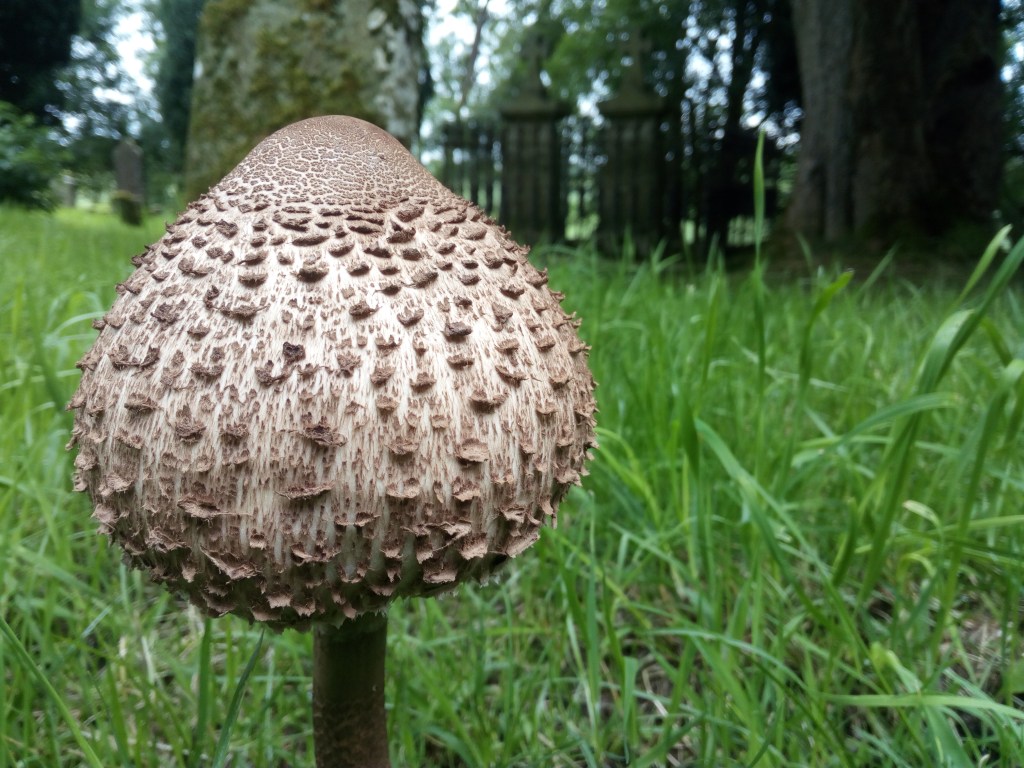
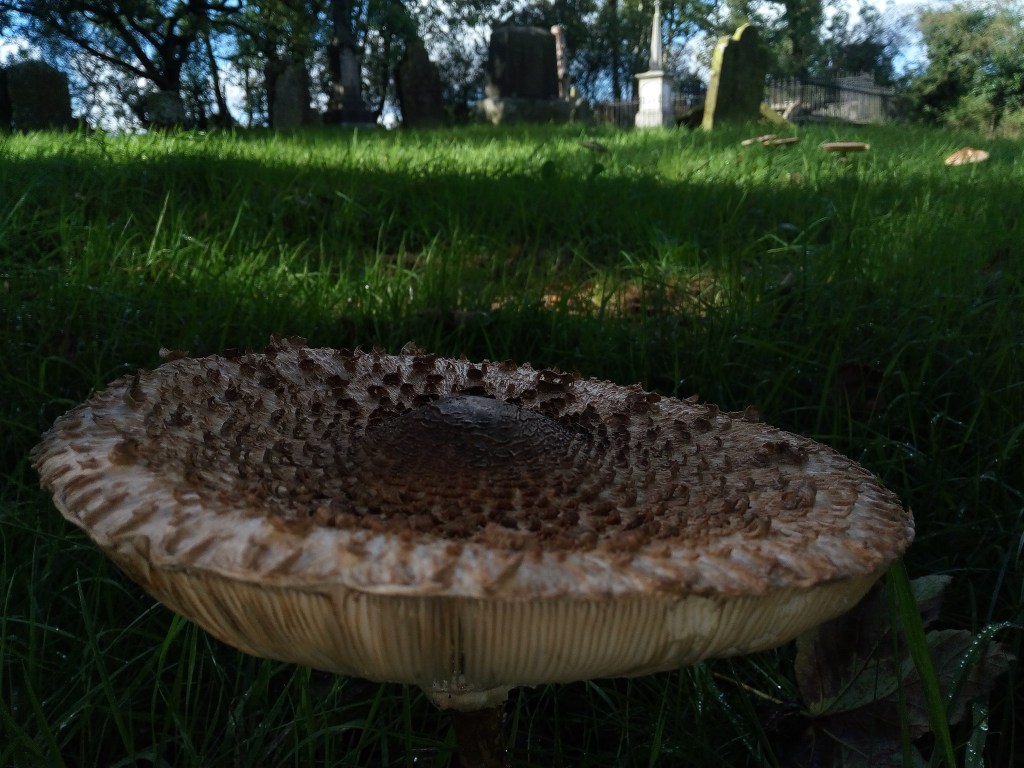
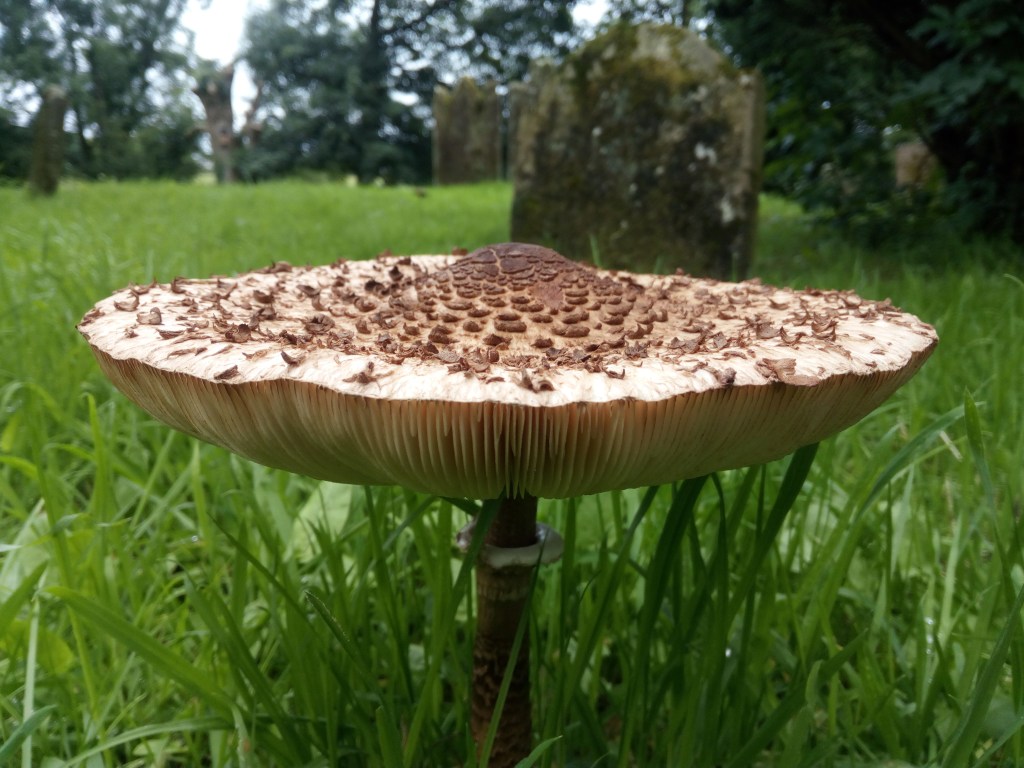
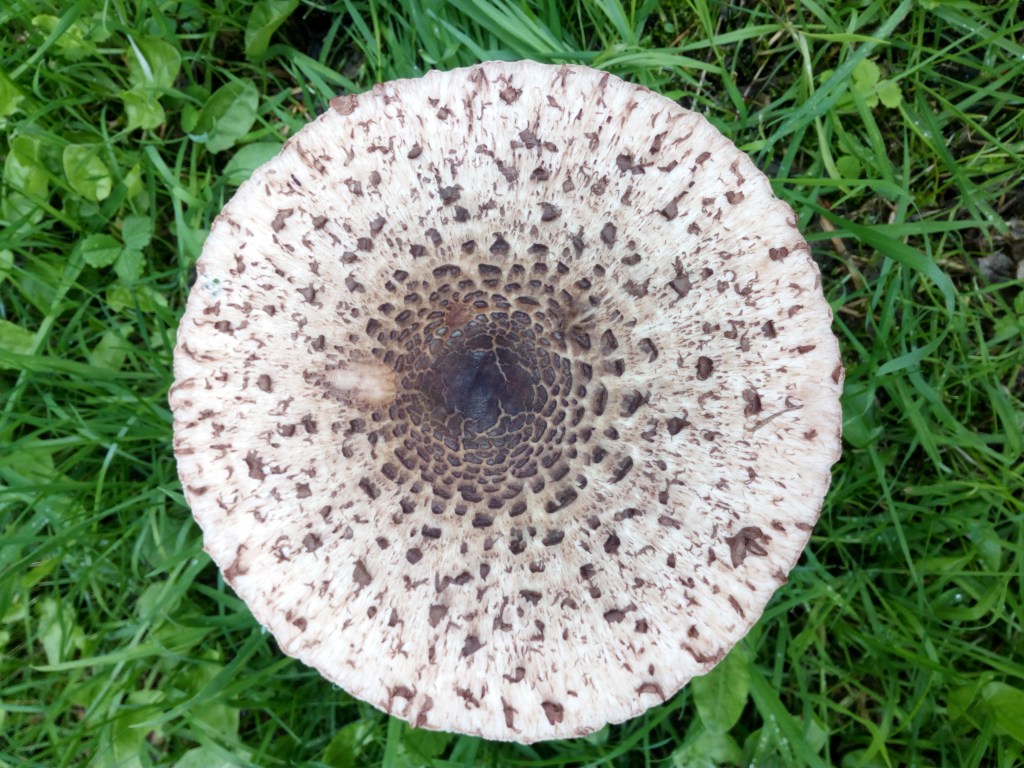
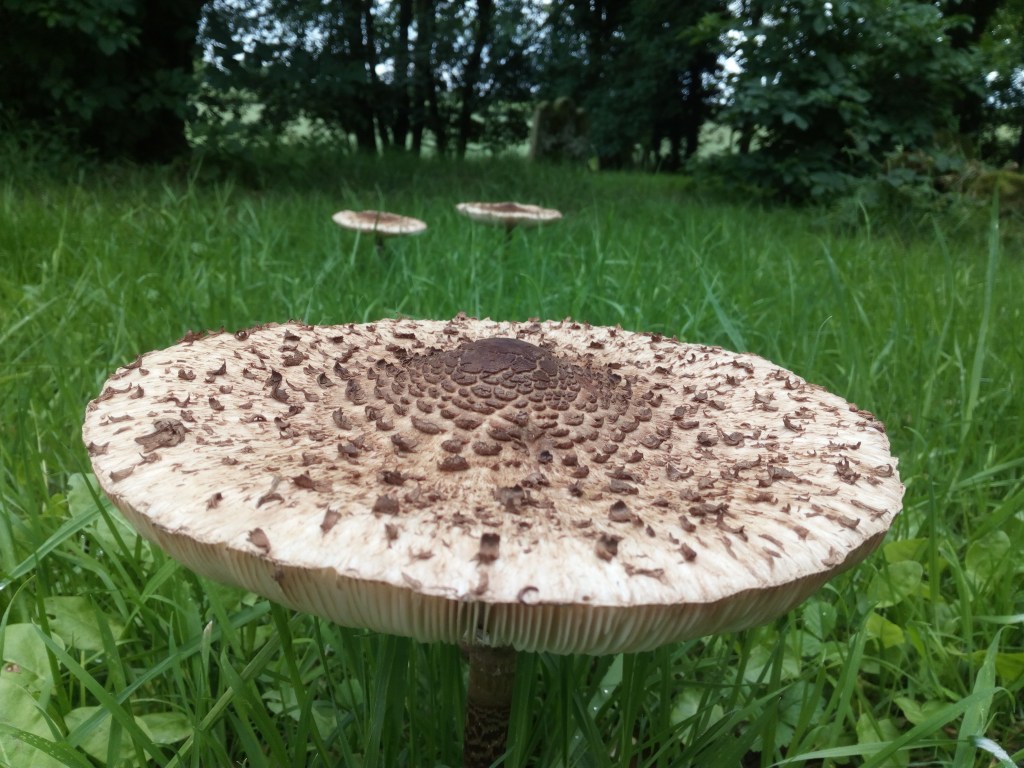
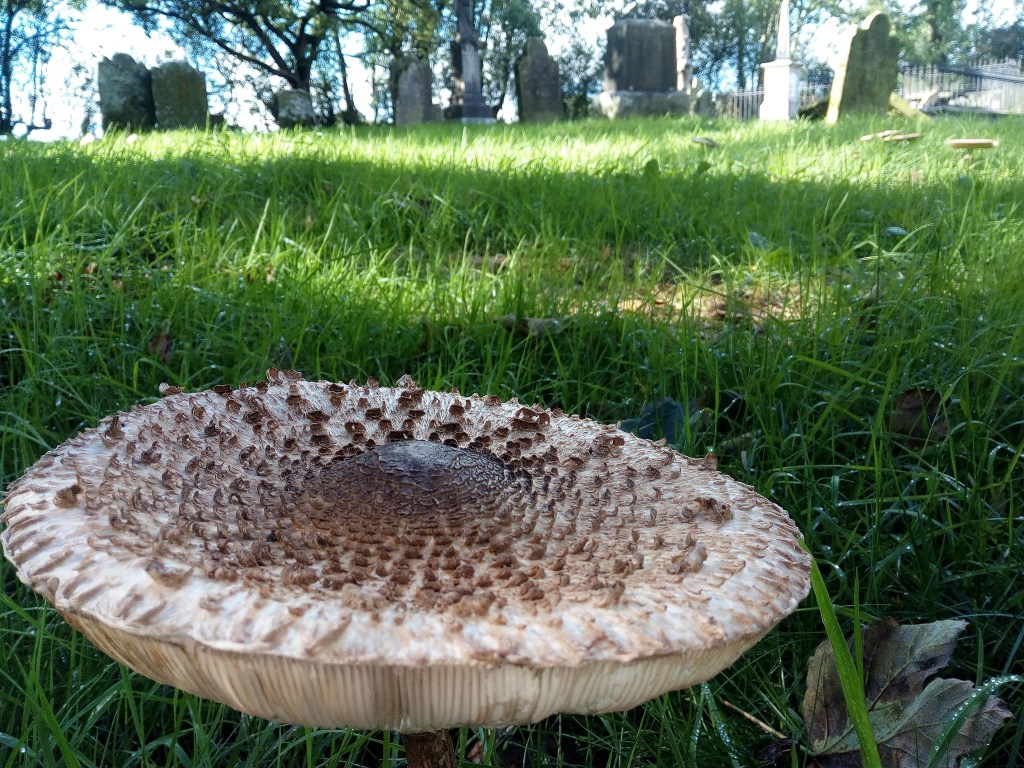
Parasols, scientific name – macrolepiota procera, can be found alone but are generally found in rings or sometimes troops. They are one of the most recognisable Irish mushrooms as few others reach the large size of the Parasol, perhaps apart from the Shaggy Parasol (we wonder if those who name mushrooms are Scooby Doo fans).
The regular Parasols are usually whiter than their Shaggy relatives, but that’s not a fixed rule. A guide is that Parasols are that little bit larger, usually, and the stem of the Shaggy Parasol will blush reddish when bruised or cut. It also does not have the snakeskin appearance of the true Parasol on its stem and has an off-white smooth appearance there.
Although both Parasol and Shaggy Parasol are edible, some people can have stomach upset when eating the latter, which must be well cooked. The Parasol will shrink a lot when cooked, so that massive mushroom you’re drooling over will not be next nor near as big when on your burger. They are described by experts as having a great mushroom flavour, which is handy given they’re mushrooms. Experts…
Finally, we will take a brief look at the most obvious mushroom of them all, given its appearance in books of nursery rhymes and fairy tales. The Fly Agaric, scientific name – Amanita muscaria, is the mushroom that faeries and gnomes have a soft spot for. It is found all over Ireland, especially in birch, spruce or pine woodland. As it is seen in Autumn to Winter, a sighting is a good sign that the colder seasons are nigh.
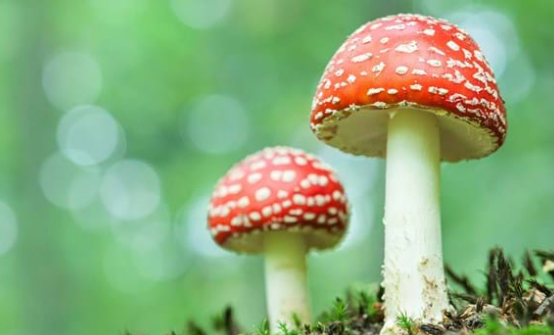
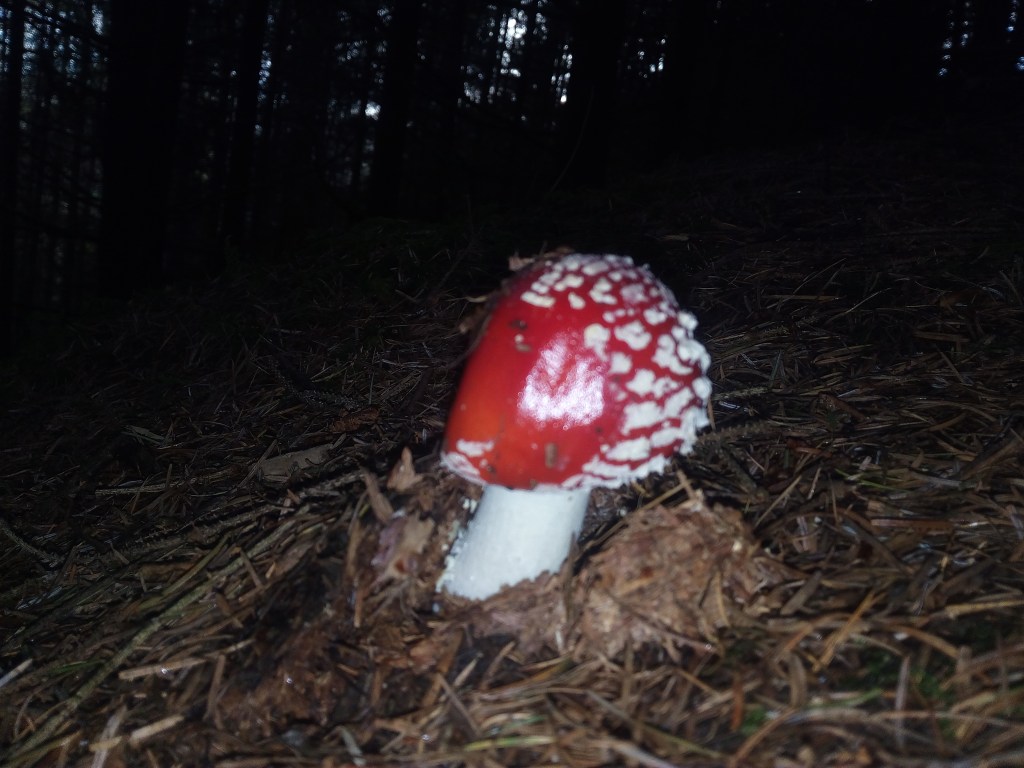
The Fly Agaric is not deemed edible, although it has been used for thousands of years in religious rituals all over the planet, including in India and Iran, where it is an ingredient in a hallucinogenic drink called Soma. It is also used in Siberia. Eating this wild mushroom is dangerous, and we expect that many earlier, or inexperienced, shamans didn’t fare too well in their vision quests. The Ballyeglish Society strongly advises against toying with the idea of eating this fungus. In the story of Alice in Wonderland, the eponymous heroine is given Fly agaric to eat. Look at just how wacky that tale was. If you start to see your cat wildly grinning at you, or your playing cards start to speak to you and then begin to dance around your kitchen, then you’ve likely ingested some Fly agaric. It is this mushroom that was thought to have inspired the modern colours of Santa’s outfit, and was common on Christmas cards in both Victorian and Edwardian times as a symbol of good luck (but not if you ate it).
Lastly, the Fly agaric was used in bygone days as an insecticide. The cap was broken up and sprinkled into a saucer of milk. The concoction both attracted and killed the flies, hence the Fly appellation. If it killed flies, then that would seem to be one further reason not to eat it, unless you’re from a millennia-old druidic tradition and have Tom Hanks chasing you through libraries.
We hope that you have found something of interest in this brief glimpse into the world of Irish mushrooms, some of which can be found at Ballyeglish Old Graveyard, and others which we hope never to see there.
Bígí linn

 The Ballyeglish Society
Leave a comment