
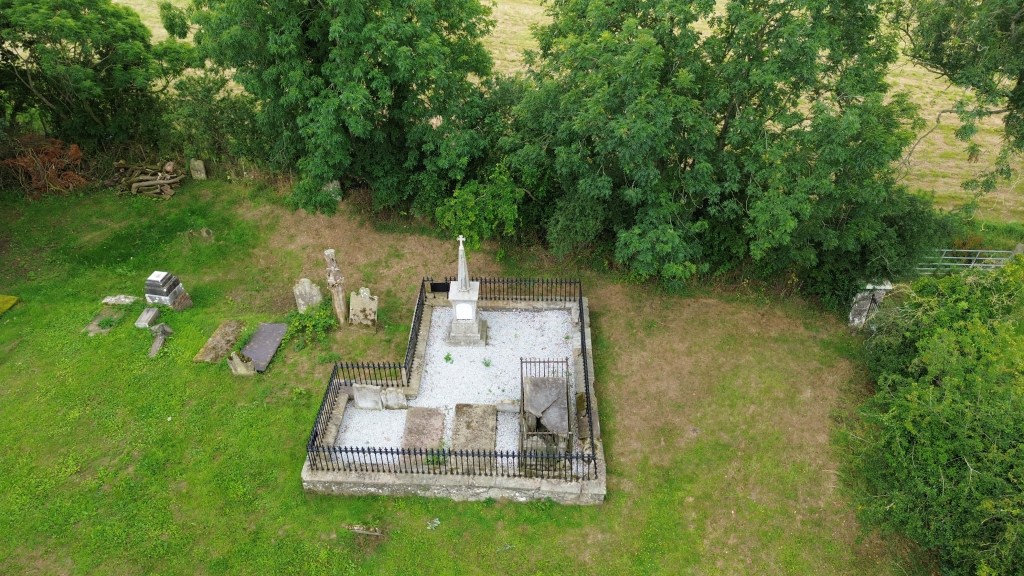
There follows an article which might be of interest to feminists, religious or those into their Irish history. It mentions Trea of Ardtrea, the eponymous saint for the parish in which Ballyeglish Old Graveyard sits. It also touches upon the lives of a number of other early Irish female saints, many of whom you might never have heard of. This brief account tells a tale in of itself, in that woman were prevalent, powerful and respected within the early Christian Church in Ireland. Their position was eventually severely weakened by religious and associated social misogyny until they became little more than servants for the men. Nuns were expected to make the tea and do the laundry as men sort out the serious stuff. Tut tut.
Therefore, the question could reasonably be asked, What would Jesus do?
We hope that the included, light article has given you food for thought with no moral indigestion. As Mr Zimmerman once sang, The times, they are a’ changing. Recent adjustments within various Protestant denominations have proved him right. A new school of thought has emerged. This has meant that women are once again returning to their original places of equality within Christian institutions. They have some way to go before being truly considered the equal of men, but are solidly getting there. Sadly, not every Protestant congregation is on board with such progressive moves. Of note, however, is the fact that Ireland was the first Anglican congregation in the Celtic Isles to appoint a female bishop (2013). The Rev. Pat Storey is from Belfast, so is yet another strong female Ulsterwoman of the church following in the footsteps of Bríghid, Bronagh and Trea (no pressure, Pat). FYI: the USA appointed their first female bishop in 1989. We await the first female primus inter pares (first among equals in the global Anglican congregation), a.k.a. The Archbishop of Canterbury.
Within the Catholic Church the wheels turn much more slowly, due in part perhaps to the monstrous size of that particular organisation, a larger vehicle having a much longer turning arc. But change is underway, albeit under some degree of serious opposition. The conversation about female priests is taking place. Influential figures, such as former President of Ireland, Mary McAleese, are speaking out about the second-class status currently afforded to women in the Catholic Church.
The incumbent, Pope Frances, has taken steps to further the rights of women in the church. In doing so, he has incurred the wrath of the more conservative, fusty-musty members of the clerical hierarchy. He has made women full members of dicastries (departments) in the Roman Curia (the administrative body of the Holy See, which is the Pope’s jurisdiction over Catholicism). In this, he is providing new access for women into the decision-making processes of the Church. But there is much work to be done and it is stating the obvious that Frances will not achieve all that he wishes in his lifetime. His successors will have a heavy baton to carry.
We can only wonder what the women who became Irish saints would make of the changes that occurred in the church in Ireland after their time. Would Bríghid have permitted anyone to move her to one side? Would Monnina, Bronagh and Trea have accepted a role as tea-makers (remember the custard creams, Trea)? It could be suspected that any who tried would have had one mighty battle on their hands.
There will surely be a certain poetical symmetry when the women of Ireland once again stand as equals with their male colleagues. We can, at that time, look with admiration upon the female saints of the future, and witness the smiles of the female saints of the past reflected in their faces.
Bígí linn

 The Ballyeglish Society
Leave a comment